


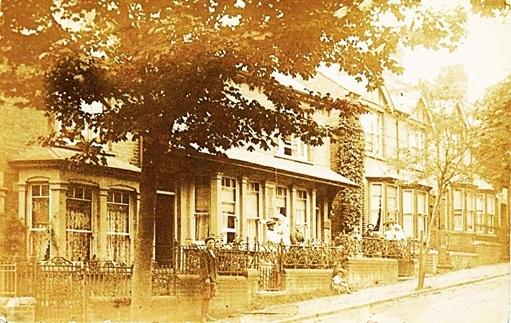
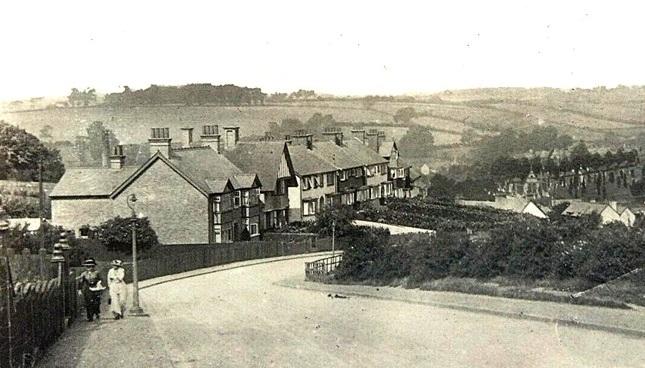
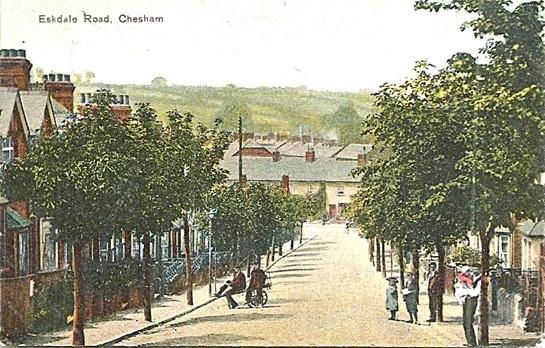

Eskdale Avenue in Chesham is well-known for its trees. It was originally two roads which met and became one. This is the story…
Newtown, Chesham
In the nineteenth century, Chesham started to grow out along Berkhampstead Road, and from the 1870s this area became known as New Town. After the Metropolitan Railway came to Chesham in 1889, this was a popular area to live because it was within walking distance of the new station.
Eskdale Road
A pub had existed in the area since 1843, called the Jolly Sportsman, owned by Nash (later called Chesham) Brewery. In March 1891, the brewery auctioned the pasture land next to pub, which was bought by Mr Patterson for £1,100. In April 1892, Mr Patterson applied to build a new road on the land, next to the pub, to be called Eskdale Road, although it is not known why he chose that name. Trees, mainly horse chestnuts and limes, were planted up the sides at regular intervals to provide shade and to make it into an attractive avenue. The houses were numbered from the bottom up. The first houses seen on an 1892 map, were Victorian semi-detached houses (now numbers 1, 3, 17, 19, 21 and 23) built on the right looking up, and houses (now numbers 10, 12, 14 and 30) on the left. Later after 1901, Edwardian houses were built and Eskdale Road stopped at numbers 66 on the left and 39 on the right. In 1905, when he had sold all the plots, Mr Patterson asked Chesham Council to take over Eskdale Road as a public highway.
Khartoum Avenue
The land above Eskdale Road was part of Taylor’s Farm, with the farm buildings at the bottom of Cameron Road. In June 1898, Messrs Vernon and Sons of High Wycombe, asked for permission to put in a new road which would be 36 feet wide, leading from the top of White Hill where it meets Botley Road and Lye Green Road, downhill towards Eskdale Road. Where the roads met then became known as Codmore Cross. Chesham Council suggested that the whole route should be called Eskdale Road, but Mr A. Vernon said that Eskdale “was a little difficult in pronunciation”. In January 1899 Chesham Council discussed four proposals for the road name, which were Hertfordshire Road, Hempstead Road, Nethercliffe Avenue and Khartoum Avenue. They chose the name
Khartoum Avenue, named after the capital of the Sudan, which had been in the news, with the Siege of Khartoum in the 1880s. From 1903, Vernon’s sold seventy building plots, which were advertised as “Near to the Metropolitan Railway Station, on high land adjoining the Town, and fronting the main thoroughfare known as Khartoum Avenue”. In 1905 electric lights were installed and in 1909 the sewer was added. By 1910, Khartoum Avenue had thirty large houses which had names and not numbers. Tenders were sought to gravel and kerb Khartoum Avenue. Later some trees, mainly lime, beech and copper beech, were planted both sides to form the road into an avenue.
Catholic church 1909-15
From 1909, two houses in Khartoum Avenue, were used by Catholic Carmelite monks from Kensington. They called them called “St Helen’s” and “Mount Carmel” (now 103 and 105 Eskdale Avenue) and linked them by a corridor. One house was used as a community house for trainee priests with a chapel and the other house was used as a seminary. The first Mass was held there on Sunday morning, May 9, 1909, and this was the start of the first Catholic church in Chesham since the Reformation. Meanwhile the Carmelites applied for planning permission to build a monastery, a church and school in Khartoum Avenue (where Harding Road is now) but this was declined. Instead in September 1913 the Carmelites moved to Chalfont St Peter, and from 1915 services moved to the newly-built church in Chesham Bois known as Our Lady’s.
Renamed Eskdale Avenue 1911
Over time as more houses were built in Khartoum Avenue, it stretched down the hill, until the avenue joined the top of the shorter Eskdale Road at the bottom. In 1910 both roads were paved as one road, and in 1911, Eskdale Road and Khartoum Avenue were renamed as “Eskdale Avenue”. In 1948, the houses in the part of Eskdale Avenue, which was formerly Khartoum Avenue, were numbered continuing the numbering from the lower avenue.
Important Occupants
Over the years a number of important people have lived in the avenue. Mrs Emily Brandon lived at Bankside, Khartoum Avenue (now 72 Eskdale Avenue). In 1910, she gathered women of Chesham to campaign for the vote, and her house was a base for Suffragette meetings. During the Second World War many Jewish people came from north London to the Chesham and Amersham area to escape the Blitz. Rev S.M. “Sonnie” Bloch was Rabbi of Amersham Orthodox Jewish synagogue, and he lived at Rosemont (now 88) Eskdale Avenue. Another well-known local occupant was Mr Arnold Baines who for many decades was a local politician and local historian, and important to the life of Chesham. He lived at Finmere (now 90) Eskdale Avenue his whole life, where he was born in 1921, until he died in 2001.
The Avenue Trees
In the early years the trees were cared for and regularly pollarded, and dead trees were replaced. In more recent decades dead trees have not been replaced and the holes were paved over, and you can see places where they used to be in the pavement. Only fifteen trees now remain. These trees provide shade and beauty to the avenue.
A 2026 Buckinghamshire Council report suggested chopping the trees down because they obstruct the footways, although it did not mention that a bus stop, telegraph poles and lamp posts and increasingly parked cars also block the footway. An avenue is, by definition, a road lined by trees, so many people who live in the avenue are now campaigning to “Keep Eskdale Avenue an avenue”.


Share